AI in Property Management: Not Every Automated System Is AI
AI in property management is becoming an important topic as more systems claim to support smarter daily operations. Today, many property management systems can send reminders, update records, display dashboards and trigger notifications automatically.
These functions are useful. They help management teams reduce manual work and keep daily operations more organised. But automation alone does not make a system an AI system.
In property management, the real difference is not whether a process happens automatically. The difference is whether the system can understand a situation, make a useful judgement and support the appropriate next action.
Automation follows rules. AI understands situations.
For property managers, management committees, building managers and strata communities, this distinction is important. It helps teams evaluate whether a system is truly using AI, or whether it is mainly providing digital automation.
What Is the Difference Between Automation and AI in Property Management?
Automation follows predefined rules.
For example, a property management system may:
- Send a reminder three days before a payment deadline
- Notify management when a visitor registers
- Update a status after a form is submitted
- Generate the same report at the end of every month
These actions improve efficiency, but the system is still following instructions that have already been defined.
AI goes further. An AI property management system can interpret information, consider context and support an outcome that is not limited to one fixed response.
In daily property operations, this matters because many issues are not reported in a perfect format. Residents and staff may describe problems in different ways, with incomplete details or through normal conversation.
A useful AI system should be able to understand what the person is trying to communicate and help the management team decide what should happen next.
A Simple Way to Recognise AI in Property Management
Property management teams do not need to understand complicated technical terms to evaluate an AI system.
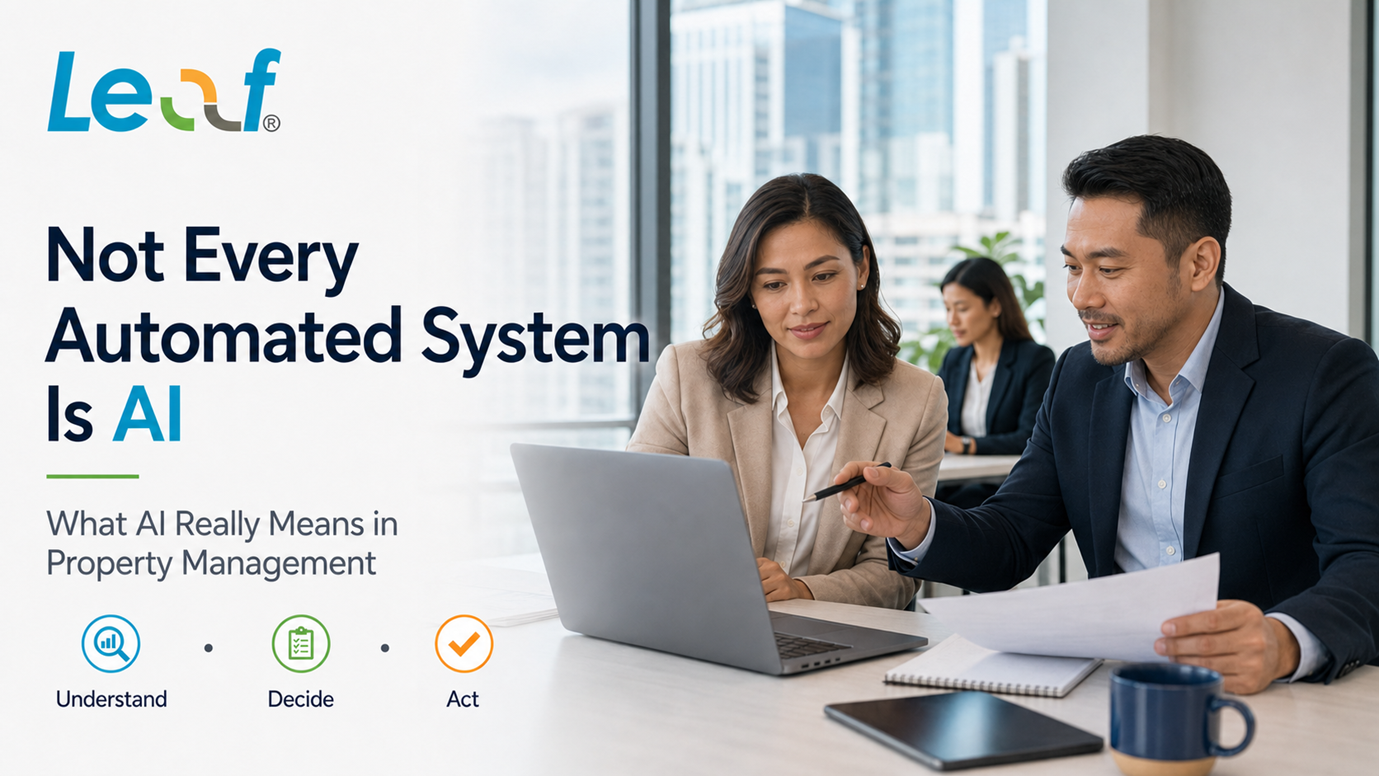
A practical way is to look for three capabilities:
-
Understand
Can the system understand everyday descriptions, incomplete information and different ways of reporting the same issue?
Residents and staff do not always use structured forms. They may describe an issue through a message, voice note or normal conversation.
An AI system should be able to understand the meaning behind the message, not only match a fixed keyword.
For example, a resident may write:
“The light near the lift entrance at the parking level has been flickering since yesterday.”
An AI-supported system should be able to recognise that this relates to a lighting maintenance issue, identify the stated location and help structure the information for follow-up.
-
Decide
Can the system identify what the issue means and support a suitable response?
This may include recognising the type of issue, urgency, location, people involved and the next action that may be required.
The result should depend on the situation, not only on a predefined button or fixed workflow.
In a property management workflow, this is important because different issues may require different handling. A water leak, lift breakdown, security concern or lighting issue may all require different urgency levels, task assignments and follow-up actions.
-
Act
Can the system turn its understanding into a useful operational outcome?
This may include supporting task creation, preparing a response, organising information, generating a report or helping the team follow up more clearly.
AI becomes more valuable when its output supports real daily work.
In property management, useful AI should not stop at giving an answer. It should help move information towards action, task tracking, resident updates and management visibility.
What This Looks Like in Daily Property Operations
Consider a resident who sends this message:
“The light near the lift entrance at the parking level has been flickering since yesterday.”
A traditional system may require the resident or management staff to select a category, enter the location, describe the issue and decide who should handle it.
A basic automated system may send a standard acknowledgement after the form is submitted.
An AI-supported property management system can understand that the message relates to a lighting maintenance issue, recognise the stated location and support the next operational action.
The management team remains in control, but less time is spent translating everyday messages into structured work.
This is the practical difference between simply receiving information and understanding what the information means.
Useful Digital Features Are Not Always AI
Many valuable property management functions do not require AI.
Examples include:
- Online forms
- QR visitor registration
- Scheduled notifications
- Digital access records
- Fixed approval workflows
- Dashboards and standard reports
- Template-based replies
These features can make property operations faster and more organised.
However, they should not automatically be described as AI. Their value comes from digitisation and automation, not necessarily from understanding or judgement.
Clear definitions help property managers evaluate a system based on what it genuinely does, not only on how it is marketed.
Why This Matters for Property Managers and Strata Communities
In condo, residential and strata property management, daily operations often involve many small but important issues.
These may include resident complaints, maintenance requests, visitor records, facility matters, payment reminders, contractor follow-up and management reporting.
If these activities are only automated, the system may still depend heavily on staff to interpret messages, decide what matters and coordinate the next step manually.
This is where AI in property management can provide practical value.
AI can help management teams understand incoming issues faster, reduce repetitive coordination and organise information into clearer operational outcomes.
AI Should Move Work Forward
Some AI tools only provide an answer or suggestion.
They may summarise a message, draft a response or explain what someone should do next. These capabilities can save time, but staff may still need to handle all the follow-up manually.
Operational AI should provide more practical support.
It should help turn information into outcomes that the team can review and use, such as:
- A clearer task description
- A recommended priority
- An organised operational update
- A structured action report
- A more consistent response
- Better visibility for follow-up
The objective is not to remove people from the process. It is to reduce the repetitive coordination work that slows people down.
Human Control Still Matters
A responsible AI system should operate with appropriate human and operational controls.
Property management teams should still be able to:
- Review the information
- Modify the recommended action
- Correct inaccurate details
- Approve important decisions
- Stop or change the next step
- Escalate sensitive situations to the right person
AI should support the judgement of the management team, not remove accountability.
The strongest approach combines AI understanding with human experience, operational rules and clear management oversight.
What Makes Property Management AI Valuable?
AI is not valuable simply because it is new technology.
It becomes valuable when it helps property teams manage daily operations more clearly.
That means helping teams:
- Understand incoming issues faster
- Reduce repeated manual coordination
- Maintain clearer task ownership
- Support more consistent responses
- Improve operational visibility
- Move issues towards action and resolution
The real measure of AI is not the presence of an AI label, chatbot or dashboard.
The real question is:
What does the system understand, what judgement does it support, and what useful outcome does it help the team achieve?
Frequently Asked Questions About AI in Property Management
Is automation the same as AI in property management?
No. Automation follows predefined rules, such as sending reminders or updating statuses. AI can interpret information, understand context and support suitable next actions based on the situation.
Can a dashboard be considered AI?
A dashboard is not automatically AI. A dashboard displays information. It becomes part of an AI-supported workflow only when the system can help interpret data, identify issues, support decisions or recommend useful actions.
How can AI help property management teams?
AI can help property management teams understand incoming messages, organise operational information, support task creation, prepare responses, improve follow-up and provide better management visibility.
Should AI replace property management staff?
No. AI should support property management staff, not replace their accountability. Human review, approval and operational control are still important, especially for sensitive issues, resident communication and management decisions.
How LEAF Approaches AI in Property Operations
LEAF helps property management teams connect everyday operational information with clearer action and follow-up.
Instead of treating AI as a separate feature, LEAF applies AI-powered support to practical property management situations, including incoming requests, operational issues, task coordination, reporting and management visibility.
The goal is simple: help property teams understand situations faster, coordinate work more clearly and remain in control of daily operations.
For communities, property managers and management teams looking to improve smart property management, AI should not be viewed as a label. It should be evaluated by the practical value it brings to daily operations.
Understand the Difference. See the Practical Value.
Not every automated system is AI, and not every property needs to start with complex AI deployment.
The right approach is to identify where AI and automation can reduce repetitive work, improve coordination and support better operational outcomes.
Contact LEAF today to arrange a walkthrough of our AI Solutions.
Related posts