
Guardhouse Bottleneck: Why It Slows Building Operations
A guardhouse bottleneck can quietly slow down building operations every day. When people think about operational costs in a building, they usually look at manpower, maintenance, utilities or vendor expenses.
But one of the most overlooked sources of daily delay is often the guardhouse.
It may look like a simple checkpoint, but in many residential, commercial and mixed-use buildings, the guardhouse handles a high volume of visitors, deliveries, contractors, vendors and ride-hailing traffic every day.
When the workflow is still manual, the guardhouse can become one of the most overloaded and under-optimised parts of the entire property operation.
The Hidden Cost of Manual Guardhouse Work
Every day, a guardhouse may need to handle:
Residents’ guests
Delivery riders and couriers
Contractors and vendors
Service providers
Ride-hailing drivers
Short-term visitors
Maintenance workers
For each entry, the same manual process may repeat.
The guard asks for details, checks the unit number, writes information into a logbook, calls for approval, records the time in and sometimes tracks exit details manually.
Each step may only take a few minutes.
But when the same process happens dozens or hundreds of times a day, the total delay becomes significant.
The cost is not only waiting time. It also creates manpower strain, resident interruptions, slower entrance flow and weaker operational visibility.
Where the Guardhouse Bottleneck Happens
The guardhouse bottleneck becomes most obvious during peak hours.
Visitors may arrive at the same time as delivery riders. Contractors may need access while residents are entering or leaving the building. Guards may need to answer approval calls while also managing vehicles, checking visitor details and monitoring the entrance.
This creates common operational problems such as:
Queues forming at the entrance
Guards writing records instead of monitoring movement
Residents receiving repeated approval calls
Delivery riders waiting longer than necessary
Contractors delayed at the checkpoint
Visitor records becoming incomplete or unclear
Management having limited real-time visibility
Even if the guard team is working hard, the process can still feel slow because the workflow itself is overloaded.
Why Adding More Manpower Does Not Fully Solve It
A common response to guardhouse congestion is to add more guards, extend the counter space or create more manual lanes.
This may help temporarily, but it does not solve the root problem.
If the workflow remains manual, the same delays remain:
More people still need to write records
More calls still need to be made
More approvals still depend on manual coordination
More records still need to be checked manually
More updates still depend on human follow-up
In the long run, adding manpower to support a slow workflow increases cost without improving the system enough.
The better solution is not only to add more people.
The better solution is to improve the visitor workflow.
A Better Approach: Fix the Workflow, Not Just the Space
Modern buildings need a visitor management process that is faster, clearer and easier to track.
Instead of depending only on manual logbooks and repeated approval calls, buildings can use digital visitor registration, self check-in kiosks and clearer approval workflows to reduce unnecessary bottlenecks.
A better visitor workflow helps:
Reduce waiting time at the entrance
Speed up visitor registration
Lower repetitive workload for guards
Reduce interruptions for residents and tenants
Create cleaner visitor records
Improve traceability and reporting
Give management better visibility over visitor activity
This changes the guardhouse from a manual checkpoint into a more structured operational flow.
To see how self check-in can improve entrance movement, read our article on Self Check-In Kiosk.
How LEAF Helps Reduce Guardhouse Bottlenecks
LEAF Smart Community helps buildings improve visitor entry through digital visitor management and Mini Kiosk solutions.
With LEAF Mini Kiosk, visitors can check in more efficiently through a structured digital process. Visitor information can be captured more clearly, approvals can become easier to manage, and records can be stored digitally for management review.
This helps reduce repeated manual work at the guardhouse and gives guards more capacity to focus on access control, security awareness and exception handling.
At the same time, management teams gain better visibility over visitor activity without depending only on manual reporting or physical logbooks.
If you want to explore smarter property workflows, visit our AI Solutions page.
Rethinking the Role of the Guardhouse
The question is not whether your building is busy.
The question is whether your current workflow can handle that volume efficiently.
A manual guardhouse does not only slow down visitor entry. It can increase operating cost, reduce visibility, interrupt residents and create pressure on guards.
A smarter visitor workflow helps buildings reduce bottlenecks, improve efficiency and create a better experience for residents, visitors, guards and management teams.
With LEAF Smart Community’s Mini Kiosk and digital visitor management tools, property teams can move from manual congestion to a faster, clearer and more scalable entrance process.
Contact LEAF today to discover how smarter visitor workflows can reduce guardhouse bottlenecks in your building.
Related posts
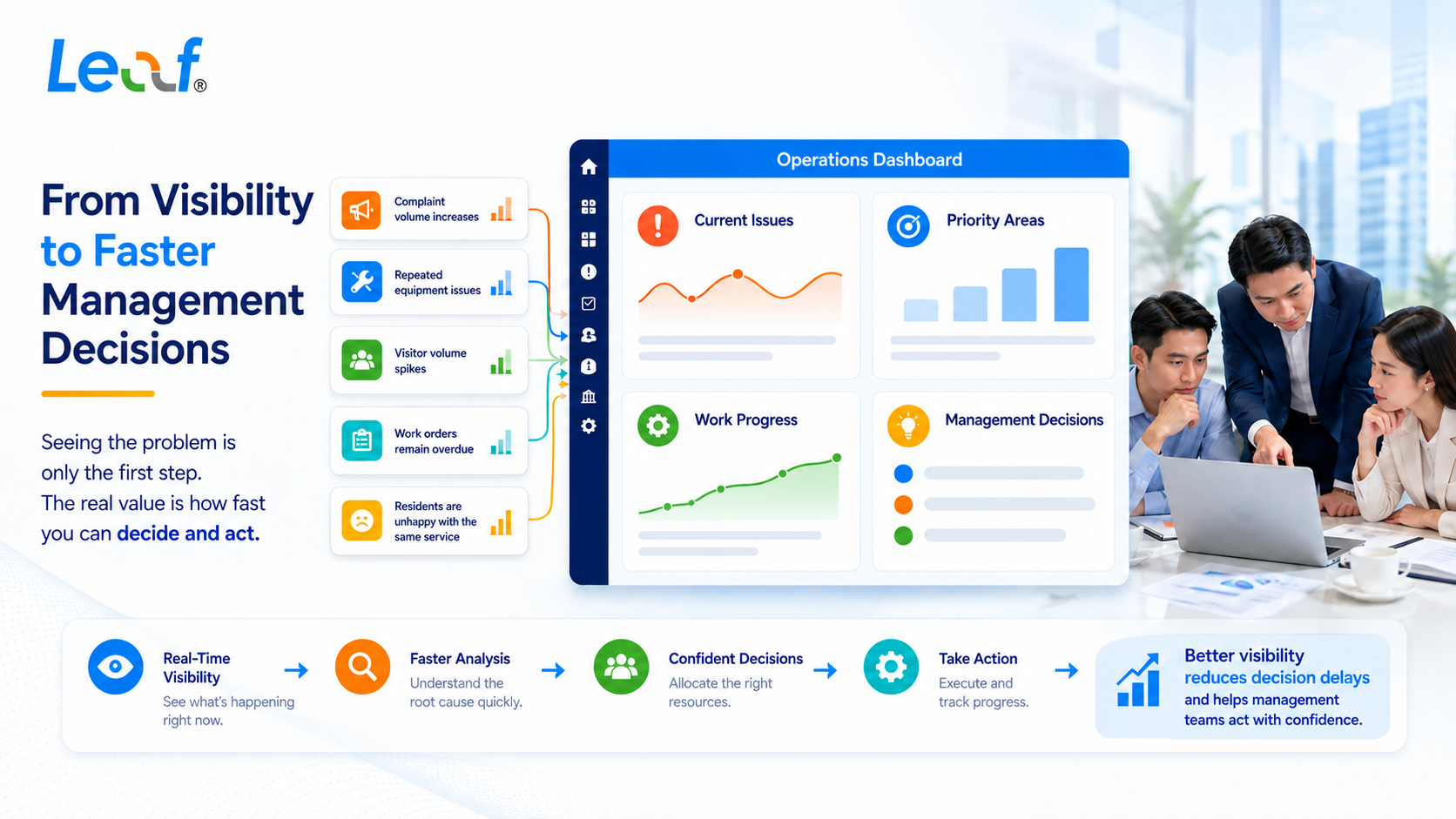
Property Operations Dashboard: From Visibility to Faster Management Decisions