The Hidden Cost of Repeated Follow-Up in Property Management
Property management follow-up often takes more time than teams realise.
They follow up with residents, vendors and internal staff. They check whether a task has been assigned, whether someone has responded and whether the issue has actually been resolved.
Follow-up is necessary. Repeated follow-up is a different problem.
Poor follow-up does more than create frustration. It creates measurable operational costs.
When the same issue requires multiple messages, calls or status checks, the cost is not limited to inconvenience. It consumes staff time, delays service, increases resident frustration and weakens trust in the management process.
What Repeated Follow-Up Looks Like
Repeated follow-up often starts with a simple request.
- A resident reports a maintenance issue.
- A staff member forwards the message to someone else.
- The management team asks for an update.
- The resident sends another message.
- The vendor asks for more information.
- Someone checks whether the task has been completed.
- The management team follows up again.
Each individual message may seem small. But across a property, dozens of similar conversations can happen every day.
The problem becomes more serious when information is spread across WhatsApp messages, spreadsheets, email, logbooks and individual staff records.
People may be working hard, but no one has a complete view of what is happening.
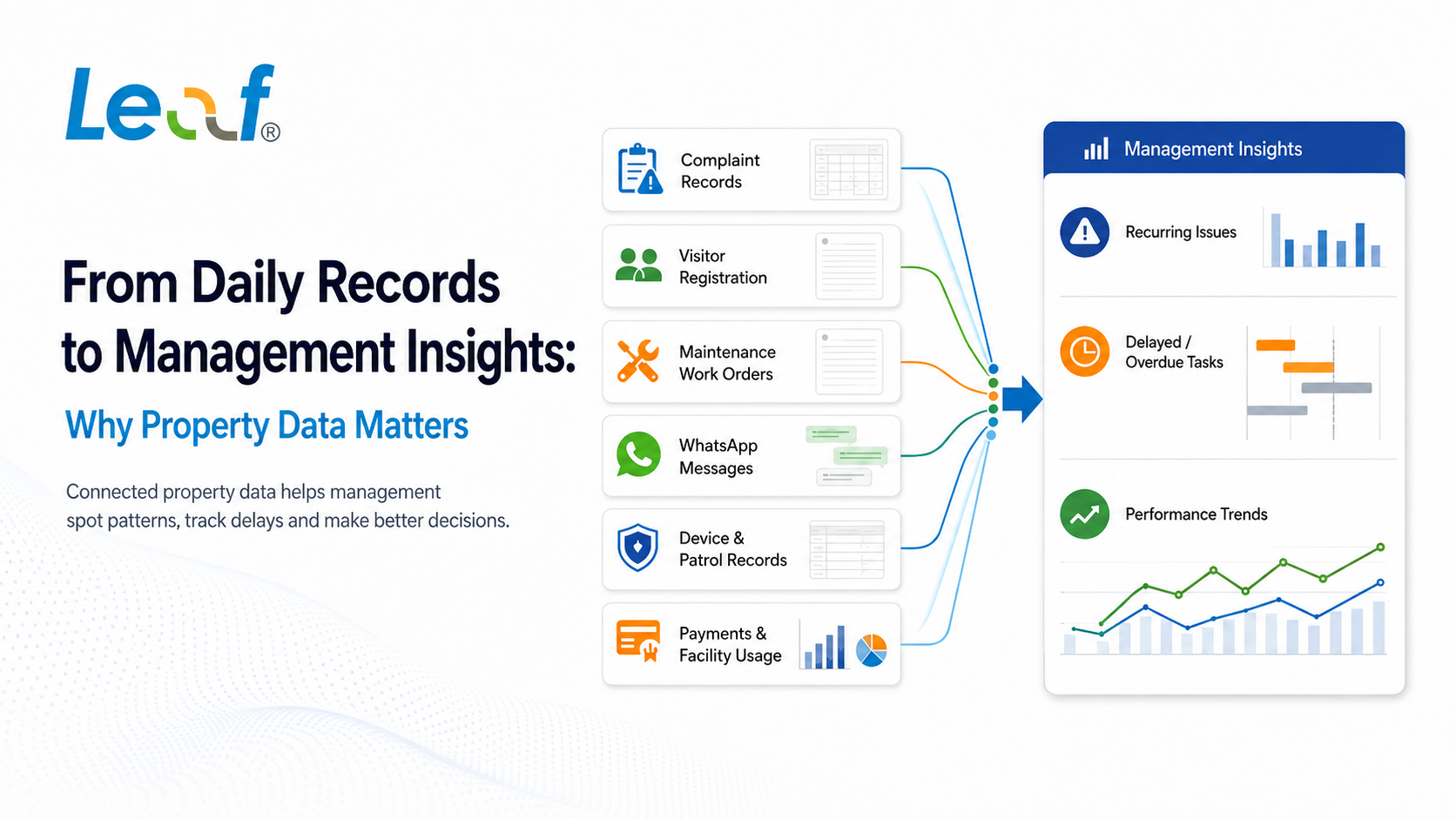
Connected property data helps management teams identify patterns across complaints, work orders, delays and resident communication. To learn how daily records can become useful management insights, read our Property Data Insights article.
To understand why visibility matters in daily operations, read our article on Property Operations Visibility.
The Hidden Cost of Poor Follow-Up
Repeated follow-up creates several types of cost.
Time Cost
Every follow-up takes time.
Staff may need to search for the original message, understand the background, identify the responsible person and ask for the latest status.
Even a five-minute check can become expensive when it happens repeatedly throughout the day.
That time could otherwise be used for resident service, preventive maintenance, vendor coordination, inspections or management planning.
Service Cost
When follow-up is unclear, small delays can become larger service problems.
A maintenance request may remain unassigned. A vendor may not know the expected completion date. A resident may not receive an update until they ask again.
The longer an issue stays unresolved, the more coordination it requires.
A simple request can eventually involve several people, multiple messages and additional escalation.
Trust Cost
Residents do not always see the internal effort behind a follow-up.
They see whether the management team responds clearly, provides updates and closes the issue.
When residents repeatedly need to ask for progress, they may feel that no one is taking ownership.
Over time, this can reduce confidence in the management team, even when staff are working hard behind the scenes.
A Simple Cost Calculation
Consider this example:
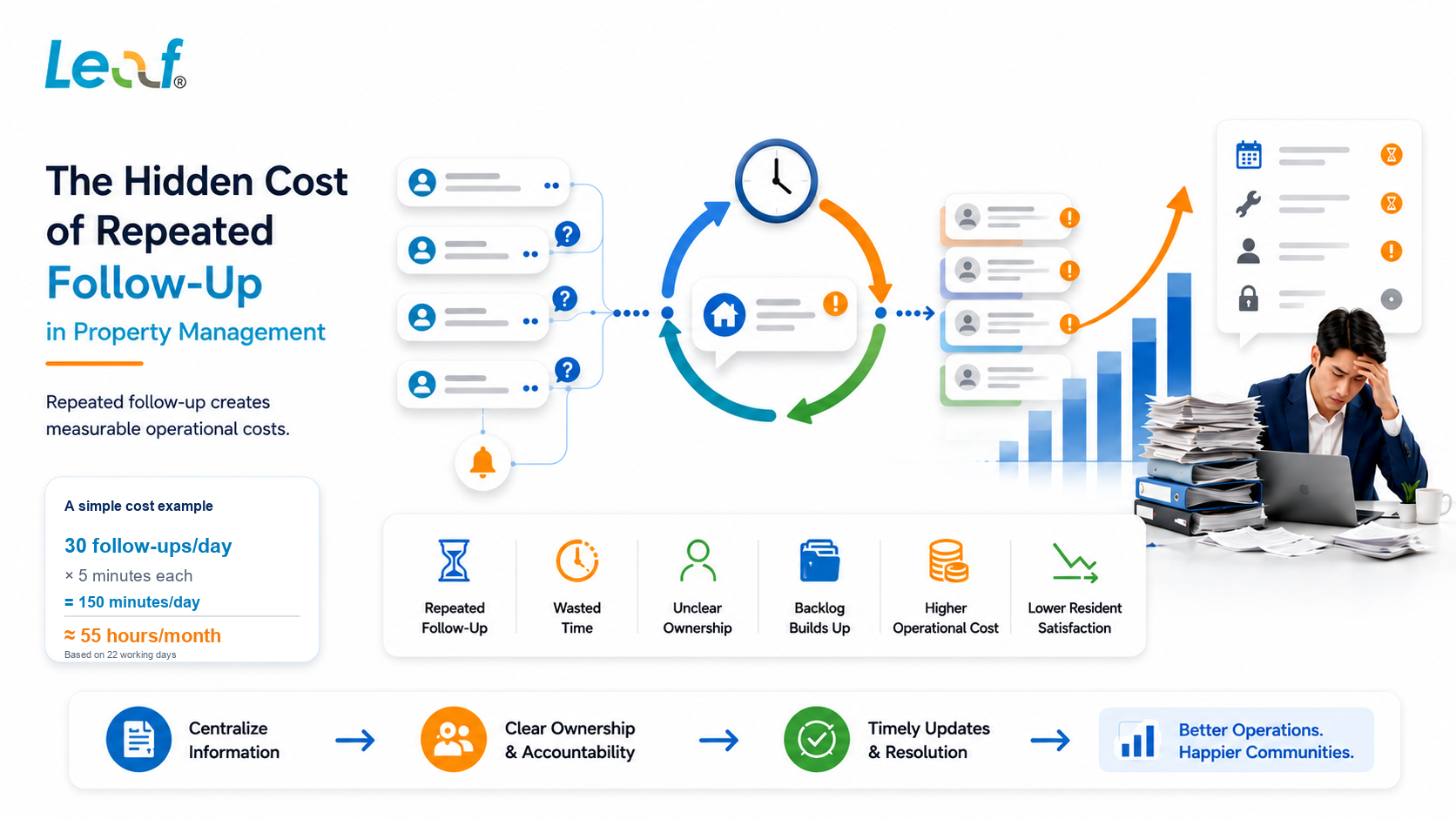
30 follow-ups per day × 5 minutes per follow-up = 150 minutes per day
That is 2.5 hours every working day.
Across 22 working days:
150 minutes × 22 days = 3,300 minutes = 55 hours per month
This is not a measure of one specific property. It is a simple illustration of how quickly repeated follow-up can become a significant operational cost.
The important point is that follow-up time is often invisible.
It may not appear as a separate expense in the budget, but it still consumes staff capacity and affects the quality of service.
Why Follow-Up Keeps Repeating
Repeated follow-up usually happens because the work is not clearly structured.
Common causes include:
- No single owner for the issue
- No clear deadline
- No priority level
- Information stored in different places
- No visible task status
- No standard escalation process
- No record of previous communication
- No clear definition of what “completed” means
When these conditions exist, people compensate by sending more messages and asking more questions.
The team is using communication to replace visibility.
But more communication does not always create better control.
Follow-Up Should Become a Trackable Workflow
A better property management process should make the next step clear.
When a resident reports an issue, the team should be able to identify:
- What is the issue?
- Where did it happen?
- How urgent is it?
- Who owns the task?
- When is it due?
- What is the current status?
- What action is required next?
- When can the task be closed?
This does not mean every issue needs a complicated system.
It means important information should be captured once, assigned clearly and made visible to the people responsible for action.
A structured process can reduce unnecessary messages because staff no longer need to repeatedly ask where things stand.
Better property management follow-up starts with clear ownership, visible task status and connected operational information. When teams can see what has been reported, assigned and delayed, they spend less time chasing updates and more time resolving issues.
If your team wants to reduce manual coordination and improve operational follow-up, explore LEAF AI Solutions.
4 Questions for Better Property Management Follow-Up
Before improving communication, management teams should ask four practical questions.
Is the information captured in one place?
If the original request is stored in WhatsApp but the status is recorded somewhere else, staff may spend time searching for the full context.
Centralised information makes follow-up faster and more accurate.
Is there a clear owner?
Every important task should have a responsible person or department.
When ownership is unclear, tasks can be forwarded repeatedly without anyone being accountable for completion.
Is there a deadline and priority?
Not every issue has the same urgency.
A leaking pipe, access problem or safety concern should not be handled in the same way as a general enquiry.
Clear priorities and deadlines help teams focus their effort.
Is completion clearly recorded?
A task is not complete simply because someone replied.
Completion should be based on an actual outcome, such as the repair being carried out, the resident being updated or the issue being formally closed.
Without a clear completion record, the same issue may return to the follow-up list.
The Goal Is Not Fewer Messages
The goal is not to eliminate communication.
Property management depends on communication between residents, management teams, vendors and service providers.
The goal is to make every important message useful.
A good follow-up process should help the team understand:
- What has happened
- What is happening now
- Who is responsible
- What happens next
- Whether the issue has been resolved
When communication is connected to ownership, deadlines and task status, the team spends less time chasing information and more time managing outcomes.
Final Thought
Repeated follow-up is often treated as a normal part of property management.
But when the same questions, messages and status checks happen every day, they become a real operational cost.
The cost appears as wasted staff time, delayed service, growing backlogs and reduced resident trust.
Better follow-up starts with better visibility.
When information is centralised, ownership is clear and progress is trackable, property teams can reduce unnecessary coordination and respond with greater confidence.
Poor follow-up does not only create frustration. It creates measurable operational cost.
Thinking About Better Property Operations?
LEAF helps property teams organise communication, tasks, follow-up and operational information in one connected workflow.
If your team spends too much time chasing updates, it may be time to review how work is captured, assigned and completed.
Talk to LEAF about building clearer and more accountable property operations.
Related posts