
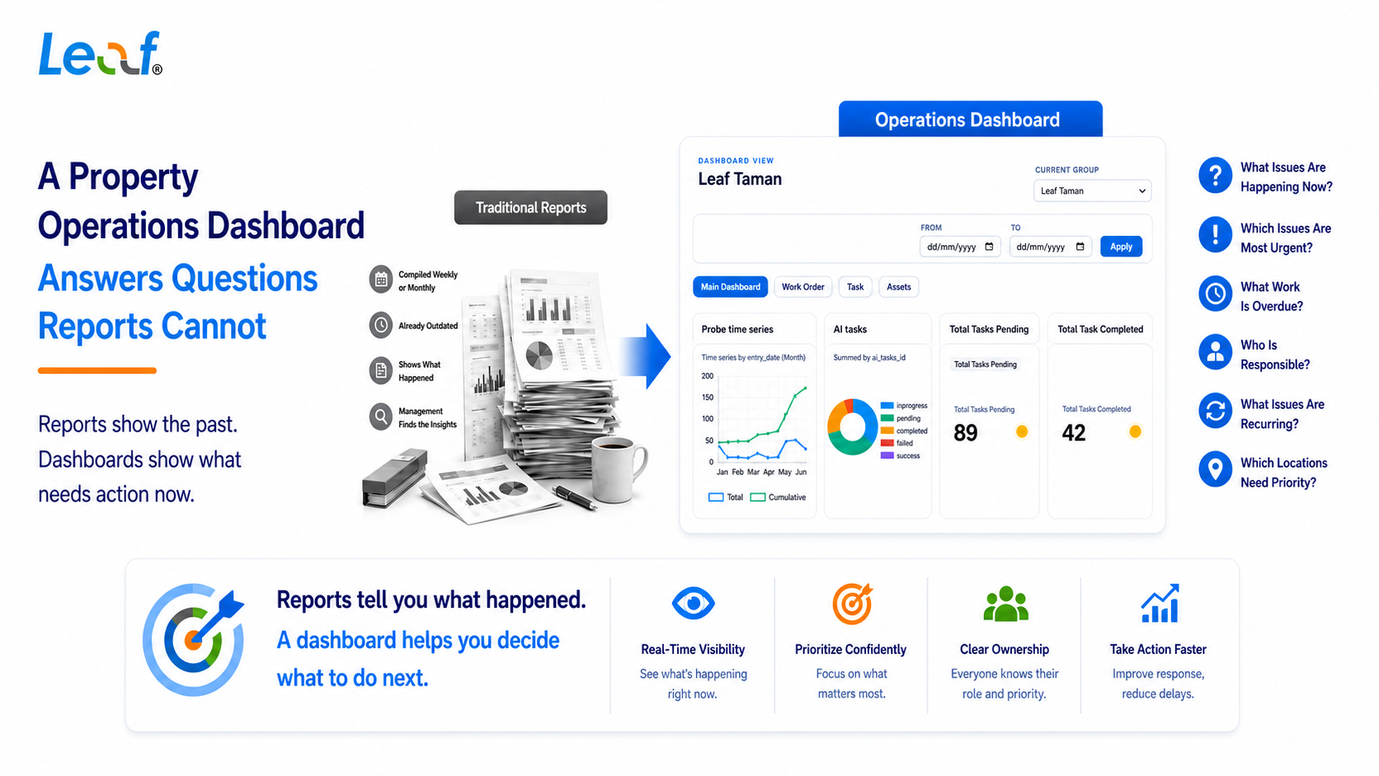
A Property Operations Dashboard Answers Questions Reports Cannot
Most property teams already have reports.
They have weekly reports, monthly summaries, maintenance records, complaint logs and task updates. These reports can be useful, but they often arrive after the important decisions should already have been made.
A report tells you what happened.
A property operations dashboard helps you understand what needs attention now.
That difference matters because property management is not only about recording information. It is about deciding what to do next.
Reports Show the Past
Traditional reports are usually prepared weekly or monthly.
By the time the report is reviewed:
A task may already be overdue
A resident may have followed up several times
A maintenance issue may have happened again
A department may already be overloaded
Management may be working from outdated information
Reports are useful for review and accountability, but they often require management teams to search for the important details themselves.
The information may be there, but the decision is not always clear.
This does not mean reports are not useful. It means reports are not always enough for daily decision-making.
To understand why daily records need to become management insights, read our article on Property Data Insights.
What Does a Property Operations Dashboard Show?
A useful dashboard brings important operational information into one view.
It can help management teams see:
What work is currently open
Which tasks are overdue
What issues are most urgent
Who is responsible for each item
Which problems are happening repeatedly
Which facilities or locations need attention
Whether work is being completed on time
The purpose is not to display more charts.
The purpose is to make the next action easier to identify.
A property operations dashboard should help management teams move from reviewing past activity to understanding current priorities.
A Dashboard Answers Practical Management Questions
A property operations dashboard should help answer practical questions that reports may not show quickly enough.
What is happening now?
Management should not have to wait until the end of the month to discover that complaints, work orders or service requests are increasing.
A current dashboard can show changes as they develop, allowing the team to investigate earlier.
This helps management respond before small issues become larger operational problems.
Which issues need attention first?
Not every task has the same urgency.
A dashboard can help separate routine work from urgent issues, such as water leakage, lift breakdowns, security concerns or repeated service failures.
This helps management focus resources where they are needed most.
When priorities are clearer, teams can spend less time discussing what matters and more time acting on the right issues.
What work is overdue?
Overdue work is often a sign of more than a missed deadline.
It may indicate unclear ownership, insufficient resources, a slow approval process or a recurring operational problem.
Seeing overdue work clearly allows management to address the cause, not only chase the individual task.
It also helps teams understand where follow-up may be breaking down.
Who is responsible?
When ownership is unclear, work slows down.
A dashboard should make it easier to see which person, team or department is responsible for the next step.
Clear ownership reduces repeated messages, avoids confusion and prevents tasks from being passed between teams without progress.
When everyone can see who is responsible, accountability becomes easier to manage.
Which problems keep coming back?
Repeated issues often reveal a deeper problem.
A recurring lift fault, repeated access card issue or ongoing complaint about the same facility may indicate that the underlying cause has not been resolved.
A dashboard helps management identify patterns instead of treating each incident as a separate case.
This allows teams to review whether a larger solution, vendor review or preventive action may be needed.
From Visibility to Action
Visibility is only the first step.
The real value comes from shortening the distance between:
Discover → Analyse → Decide → Act
For example, a property management team may notice that complaints about a facility have increased.
The team can then:
Review the issue trend
Check the location and timing
Identify the responsible department
Prioritise the work
Assign the right resources
Track whether the issue is resolved
Without a connected view, this process may depend on separate spreadsheets, WhatsApp messages, emails and individual knowledge.
With a clearer dashboard, the same decision can happen faster and with better information.
To see how poor visibility creates delays, read our article on Property Operations Visibility.
Why This Matters to JMBs, MCs and Property Managers
JMBs, MCs and property managers often need to make decisions with limited time and incomplete information.
They may need to decide:
Where maintenance resources should be allocated
Which work orders require escalation
Whether a recurring issue needs a larger solution
Which department needs support
Whether resident service levels are improving
Which problems should be discussed at the next management meeting
A dashboard gives the team a shared operational view.
Instead of relying only on personal impressions, management can discuss the same information and agree on the next action more confidently.
This is especially important in communities where different people are involved in daily decisions, including management office staff, building managers, committee members, vendors and service teams.
When everyone works from clearer information, discussions become more practical and decisions become easier to follow through.
A Dashboard Is Not Just a Collection of Charts
A dashboard is only useful when it helps people act.
A screen full of charts may look impressive, but it does not automatically improve property operations.
A useful property operations dashboard should connect information to practical decisions:
A task should have an owner
A delay should be visible
An urgent issue should be prioritised
A repeated problem should be recognised
A completed task should be traceable
The goal is not more reporting.
The goal is better management visibility.
A good dashboard should help management understand what needs attention, why it matters and what should happen next.
Better Visibility Improves Follow-Up
Many follow-up problems happen because management teams cannot easily see the latest status.
A resident may ask for an update. A staff member may need to check with another person. A vendor may be waiting for confirmation. A manager may not know whether the issue is still pending or already completed.
Without clear visibility, teams spend more time asking for updates than moving work forward.
A property operations dashboard can help reduce this by showing current work status, ownership and pending items more clearly.
This does not remove the need for communication.
It makes communication more useful because everyone is working from a clearer view of the same operational information.
From Reports to Faster Decisions
Reports and dashboards both have value, but they serve different purposes.
Reports help management review what happened.
Dashboards help management decide what needs action.
A report may show how many tasks were completed last month. A dashboard can help show what is still pending today.
A report may show that complaints increased. A dashboard can help show where they are happening, whether they are recurring and which issues require attention first.
A report may summarise activity. A dashboard helps management respond.
This is why property operations dashboards are becoming more important for modern property management teams.
They help teams move from delayed reporting to more active operational decision-making.
How LEAF Supports Property Operations Visibility
LEAF helps property teams connect operational data, tasks and management visibility in one clearer view.
Instead of relying only on reports, messages and spreadsheets, management teams can gain better visibility over current issues, pending work, repeated concerns and task ownership.
This helps teams understand what is happening now, not only what happened before.
With clearer visibility, property teams can reduce decision delays, improve follow-up and respond to operational issues with greater confidence.
If you want to explore smarter property workflows, visit our AI Solutions page.
Final Thought
Reports tell you what happened.
A property operations dashboard helps you decide what to do next.
When management teams can see current work, overdue items, recurring issues and clear ownership, they can reduce decision delays and respond with greater confidence.
Better visibility does not replace management judgement.
It gives management the information needed to use that judgement more effectively.
Thinking About Better Property Operations?
If your team is spending too much time searching through reports, messages and spreadsheets, it may be time to build a better view of what is happening now.
LEAF helps property teams move from static reports to clearer operational visibility.
Talk to LEAF about building clearer property operations visibility for faster, more confident management decisions.
Related posts
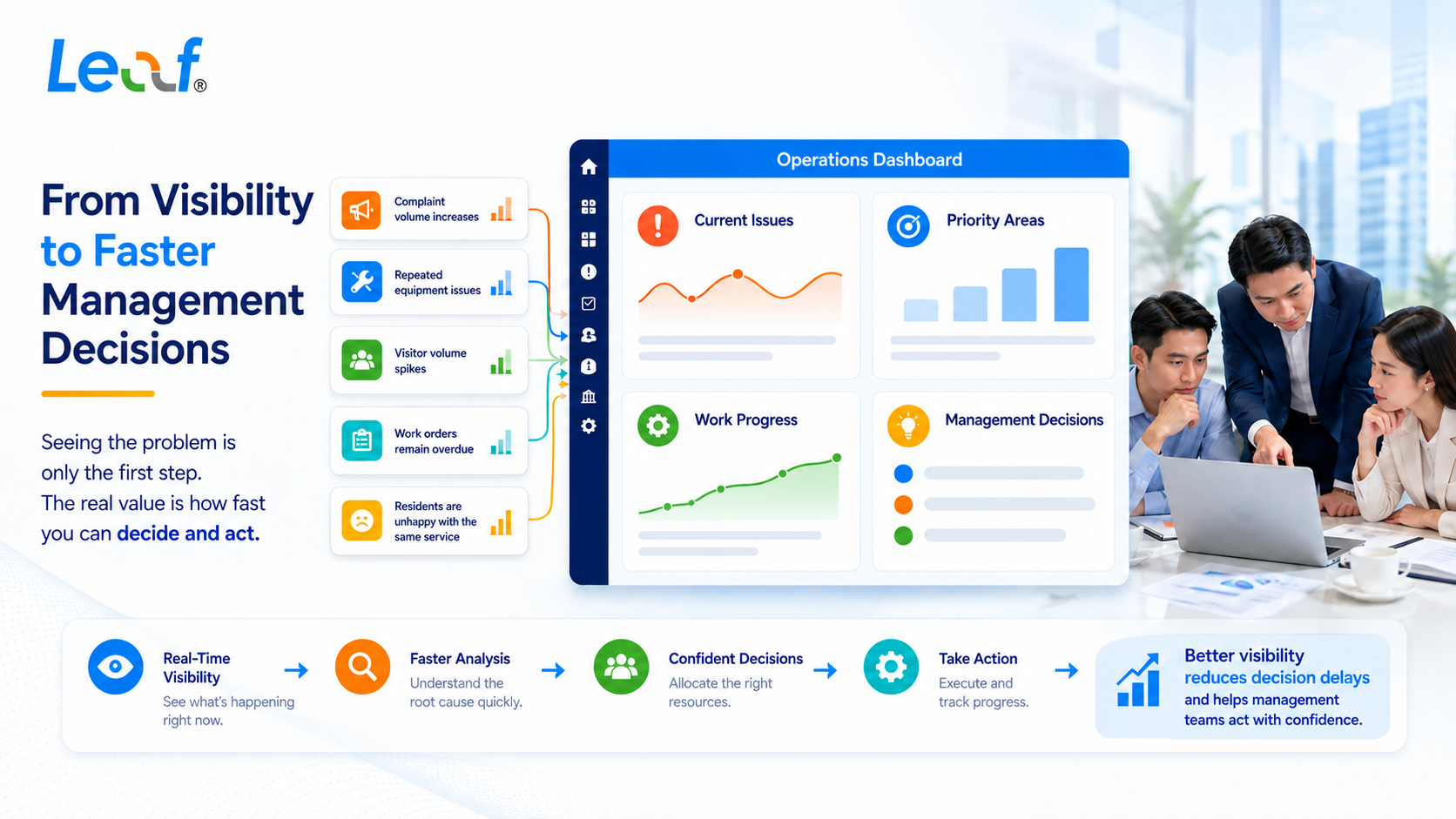
Property Operations Dashboard: From Visibility to Faster Management Decisions