
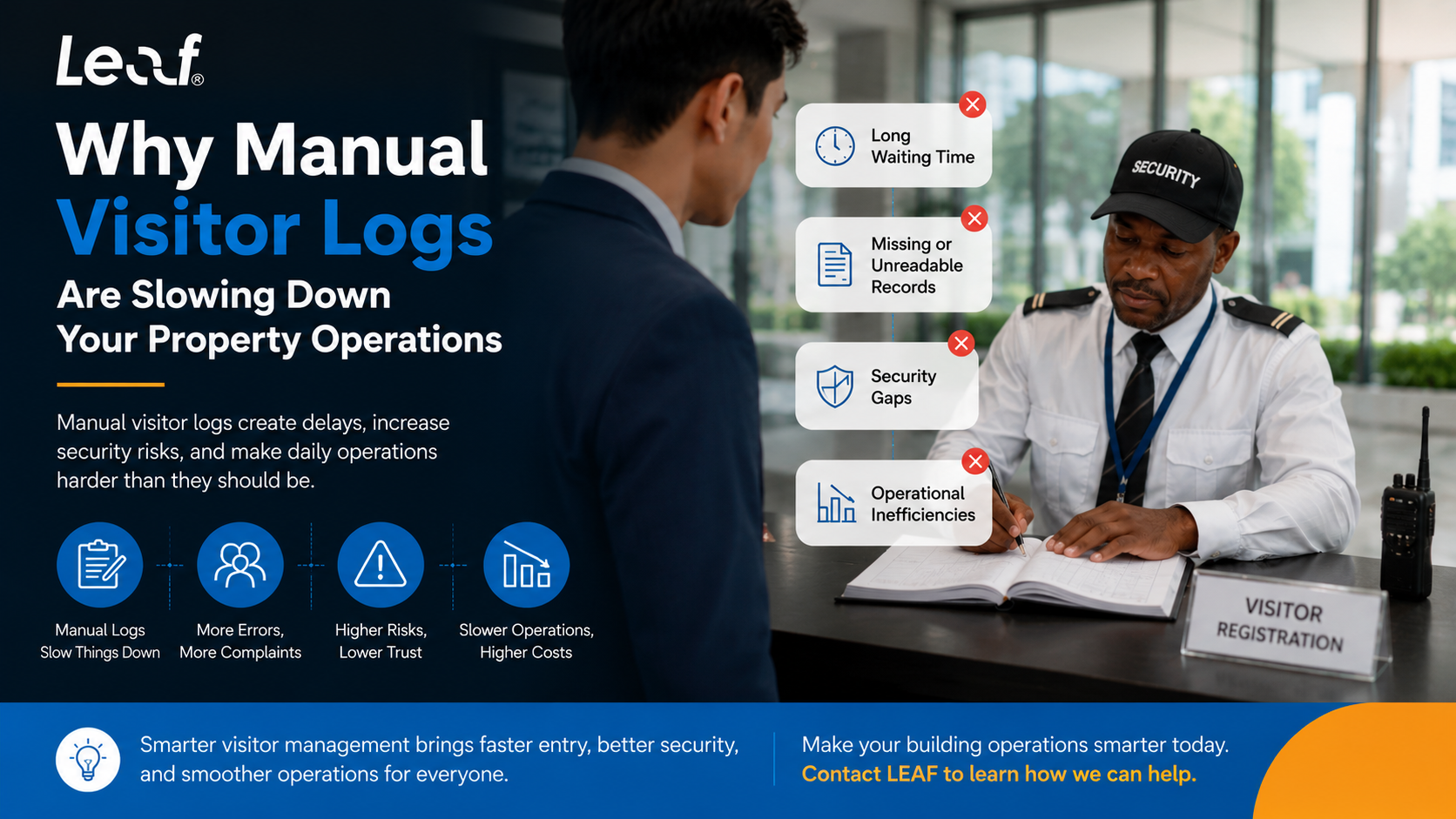
Manual Visitor Log: Why It Slows Property Operations
A manual visitor log may look simple, but it often slows approvals, creates incomplete records, and makes visitor tracking harder during busy periods.
Many residential and commercial properties still rely on manual visitor registration at the guardhouse. A visitor arrives, the guard passes over a logbook, and the visitor writes down their name, IC number, vehicle plate, unit number and purpose of visit.
This process feels familiar. For many years, it was the standard way to record visitor entry.
But in modern property operations, a manual visitor log can quietly create delays, weak visibility and unnecessary pressure on guards, residents and management teams.
Small Delays Can Become Bigger Operational Problems
Every visitor interaction affects the flow of your building.
During peak hours, delivery riders may arrive at the same time as contractors, residents’ guests and service providers. Guards may need to check details, call residents for approval, record vehicle numbers, manage queues and monitor the entrance at the same time.
Each manual registration may only take a few minutes. But across dozens or hundreds of visitors every week, those small delays add up quickly.
This can lead to:
Longer waiting times at the guardhouse
More interruptions for residents
Higher workload for guards
Slower visitor approvals
More congestion during busy periods
A building entrance should support smooth movement. It should not become a bottleneck for daily operations.
Manual Visitor Logs Create Weak Visibility
The problem with paper records is not only speed. It is visibility.
A physical visitor logbook does not give management teams a clear real-time view of who has entered the property, who approved the visit, when the visitor arrived, and whether the record is complete.
When records are handwritten, teams may face common problems such as:
Unreadable handwriting
Missing visitor details
Incomplete vehicle information
Wrong unit numbers
Delayed reporting
Difficult visitor history checks
No real-time dashboard visibility
If management later needs to verify a visitor record, investigate an incident or check past entry history, the process becomes slow and unreliable.
A manual visitor log may store information, but it does not make that information easy to search, review or act on.
Approval Delays Affect Residents and Guards
Visitor approval is another area where manual registration creates friction.
In many properties, guards still need to call residents or wait for confirmation before allowing entry. During busy periods, this slows down the entrance flow and puts pressure on everyone involved.
For example, a resident may be in a meeting and unable to answer the phone. A delivery rider may be waiting at the entrance. A guest may not know the exact unit number. The guard may need to manage other incoming vehicles at the same time.
Without a better visitor workflow, simple entry approvals can become repeated interruptions for residents and extra coordination work for guards.
A digital visitor management system helps reduce this pressure by making visitor information easier to capture, verify and track.
Guards Should Focus on Security, Not Paperwork
Security guards play an important role in protecting the property. Their focus should be on managing access, observing activity, responding to situations and maintaining safety.
However, manual visitor logs turn guards into data entry staff.
When guards spend too much time writing, checking, calling and searching through paper records, less attention goes to actual security and entrance control.
Manual paperwork also increases the risk of human error. During busy periods, details may be skipped, written incorrectly or entered without proper verification.
Reducing repetitive paperwork helps guards focus on the work that matters most: keeping the property secure and managing real situations effectively.
Residents Expect Faster and More Professional Entry
In today’s communities, residents expect convenience in daily services. They use mobile apps, online banking, e-wallets and digital communication every day.
When their guests still need to wait at a guardhouse and write details manually, the experience can feel outdated.
Modern visitor entry should be:
Fast
Clear
Secure
Traceable
Professionally managed
A smoother visitor process improves not only visitor experience, but also residents’ confidence in how the property is managed.
Why Digital Visitor Management Works Better
A digital visitor management system helps property teams move from manual recording to a clearer and more structured visitor workflow.
Instead of depending only on handwritten records, management teams can create digital visitor records that are easier to search, track and review.
Digital visitor management can help buildings:
Reduce waiting time at the guardhouse
Support faster visitor registration
Improve visitor record accuracy
Create searchable visitor history
Strengthen traceability and reporting
Reduce repetitive guardhouse workload
Improve visibility for management teams
This gives property teams better control over visitor entry without adding unnecessary manual work.
To understand how visibility affects daily follow-up, read our article on property operations visibility.
How LEAF Helps Improve Visitor Workflows
LEAF Smart Community helps buildings streamline visitor registration with digital visitor management and Mini Kiosk solutions designed for modern property operations.
With LEAF, property teams can reduce manual guardhouse registration, improve visitor tracking and create clearer records for management review.
The goal is not only to replace paper with a screen. The goal is to improve the full visitor workflow, from arrival and registration to approval, record keeping and operational visibility.
By making visitor information easier to capture and track, LEAF helps guards work more efficiently, residents experience fewer interruptions and management teams maintain better oversight.
If you are exploring smarter visitor workflows, visit our AI Solutions page.
Make Visitor Entry Faster and Smarter
Manual visitor logs may feel simple, but they often create hidden delays and weak visibility in daily property operations.
As communities become busier, buildings need visitor workflows that are faster, clearer and easier to manage.
With LEAF Smart Community, property teams can move from manual visitor registration to smarter visitor management that supports better efficiency, stronger traceability and smoother daily operations.
Contact LEAF today to discover how smarter visitor workflows can improve your property operations.
Related posts


Property Operations Dashboard: From Visibility to Faster Management Decisions

1 Comment
Comments are closed.
Pingback: Digital Visitor Log: What Changes After Logbooks