What Level of AI Are You Actually Buying?
AI levels are becoming more important as more products claim to use AI. But not every AI system can do the same kind of work.
A chatbot may answer a question. An AI workflow can follow defined steps. An agentic system can make limited decisions within boundaries and take action.
So the real question is not:
“Does this product use AI?”
The better question is:
“What level of work can this AI reliably handle?”
The L1–L5 model in this article is LEAF’s practical framework for understanding AI capability. It is not a universal industry standard, but a way to evaluate what an AI system can actually do.
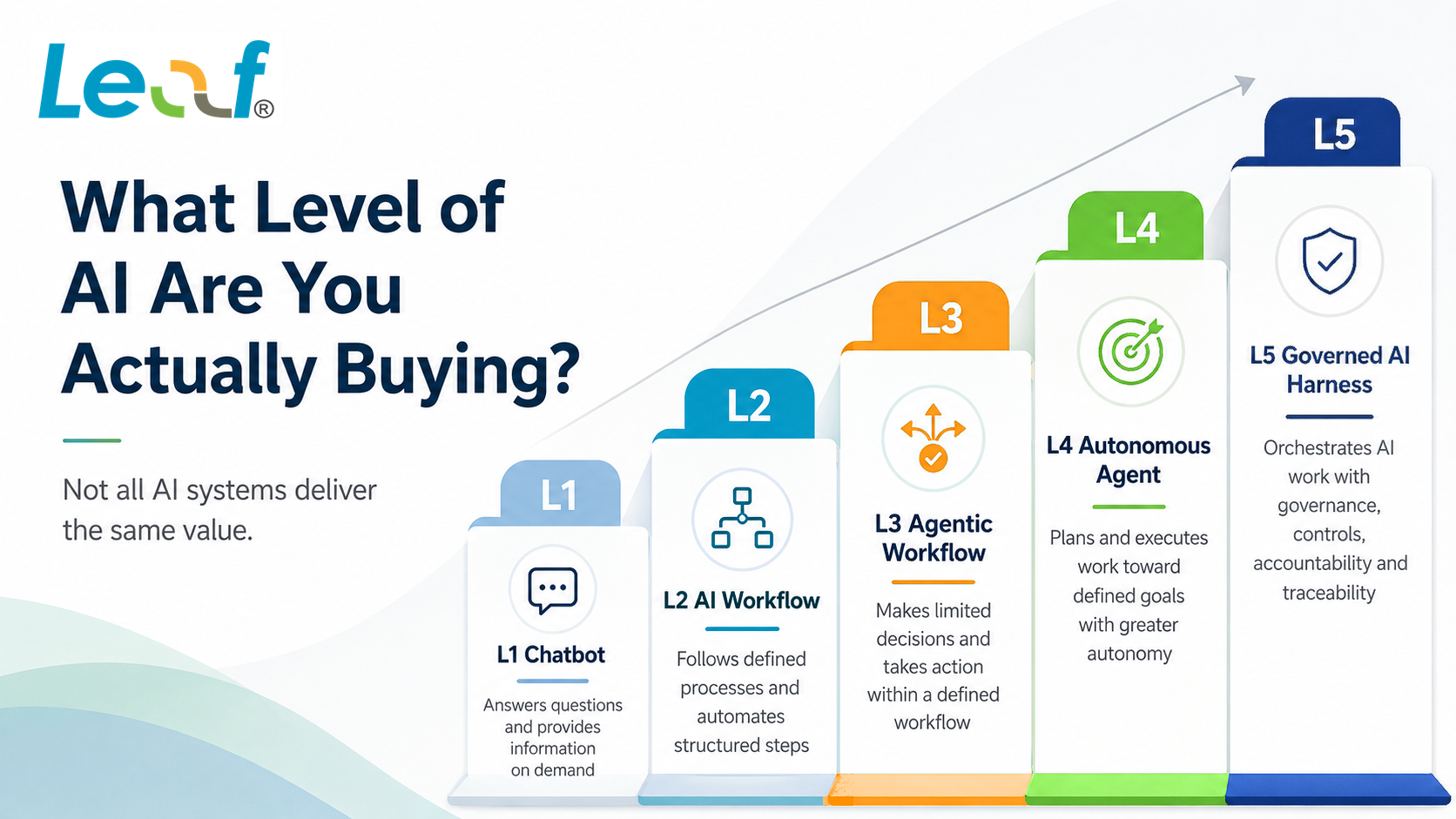
Not all AI systems deliver the same value. Some provide answers. Some automate steps. Some help move work forward. Some can work toward goals. The most mature systems operate with governance, controls, accountability and traceability.
Understanding these AI levels can help buyers avoid confusion, compare systems more clearly and choose the right level of AI for their business needs.
What Are AI Levels?
When people say they “use AI,” they often group very different systems into the same category.
But in practice, AI systems can operate at very different levels of capability.
Some AI tools only answer questions. Some are added into fixed workflows. Some can decide what to do next within approved boundaries. Some can work toward a defined goal. The most advanced systems can coordinate AI work across tools, people, permissions and governance rules.
This difference matters because the value of AI is not defined by the label.
It is defined by what the system can reliably do.
A system with a chat interface is not automatically advanced. A workflow with AI inside it is not automatically agentic. A tool-calling system is not automatically autonomous. A system that appears impressive in a demo is not automatically ready for long-term business use.
That is why buyers need a simple way to understand AI levels before making investment decisions.
The 5 Levels of AI Capability
The following L1–L5 framework provides a practical way to compare AI capability.
| Level | Name | Short Description |
|---|---|---|
| L1 | Chatbot | Answers questions and provides information on demand |
| L2 | AI Workflow | Follows defined processes and automates structured steps |
| L3 | Agentic Workflow | Makes limited decisions and takes action within a defined workflow |
| L4 | Autonomous Agent | Plans and executes work toward defined goals with greater autonomy |
| L5 | Governed AI Harness | Orchestrates AI work with governance, controls, accountability and traceability |
This framework helps buyers understand what they are actually buying: answer generation, workflow automation, controlled AI action, autonomous execution or governed AI operating capability.
Level 1: Chatbot
A chatbot is the most familiar form of AI.
It answers questions, summarises content, translates text, generates drafts or provides information on demand.
This level can be useful. It can help users write faster, understand information more quickly or receive basic guidance.
However, a chatbot does not take responsibility for getting work done.
You still need to decide what to do next.
You still need to move the work forward.
You still need to complete the follow-up.
You still own the outcome.
For example, in property management, a chatbot may help draft a response to a resident message. But after that, staff still need to check the issue, assign the task, contact the vendor and update the resident.
At L1, what you bought is AI answer generation.
For property teams exploring practical AI applications, LEAF’s AI Solutions show how AI can support resident communication, workflow assistance and daily operations.
Level 2: AI Workflow
At Level 2, AI is placed inside a predefined workflow.
The system may classify documents, summarise tickets, draft emails, organise data or process information as part of a fixed sequence.
This is more useful than a standalone chatbot because AI is connected to a process.
However, the workflow itself is still designed in advance. The order of steps is fixed. The rules are fixed. The system normally follows instructions that humans have already defined.
When something unusual happens, the workflow may stop, fail or hand the case back to a person.
For example, in property management, an AI workflow may receive a complaint, classify it as maintenance, generate a draft reply and place it into a predefined task queue.
That is helpful, but the AI is still operating inside a fixed structure.
At L2, what you bought is workflow automation with AI inside it.
AI workflows become more valuable when they are connected to real operational processes, such as request tracking, follow-up and property operations visibility.
Level 3: Agentic Workflow
At Level 3, AI can make limited decisions and take action within a defined workflow.
This is where the system becomes more practical for operational work.
An agentic workflow can understand context, choose from approved next steps, recommend priority, create tasks, route work, escalate issues or support follow-up based on business rules and situational judgement.
This is more advanced than simple automation because the system is not only following a fixed path. It can make limited decisions within boundaries.
However, it is still not fully autonomous.
The AI operates inside a defined workflow, with clear rules, permissions and limits. Important decisions may still require human review or approval.
For example, in property management, an agentic workflow may read a resident complaint, identify it as a water leakage issue, recognise that it is urgent, create a task for maintenance, recommend escalation and prepare a resident update for review.
At L3, what you bought is AI that can help move work forward within a controlled process.
In property management, this can include handling complaints, routing tasks and supporting follow-up through structured AI-powered WhatsApp operations.
Level 4: Autonomous Agent
Level 4 is where many buyers think they are buying, even when they are not.
At this level, AI is given a goal rather than a simple script.
An autonomous agent can break work into steps, choose tools, gather information, follow up, adapt to what happens and continue until it produces a usable outcome or clearly explains why it cannot complete the work.
This is different from a chatbot because it does not only answer.
It is also different from a fixed AI workflow because it can plan and adjust its actions based on the situation.
For example, in property management, an autonomous agent may be given a goal such as:
“Prepare a summary of unresolved maintenance issues this month and identify which cases need urgent follow-up.”
To complete this goal, the AI may need to collect complaint records, check work order status, review resident updates, identify overdue cases and prepare a management report.
At L4, what you bought is not just output.
You bought AI that can work toward an outcome.
Voice-based workflows can also support incoming requests and operational coordination through LEAF Voice Management, especially when AI needs to help teams capture, organise and move work forward.
Level 5: Governed AI Harness
Level 5 is the enterprise level.
At this level, AI is not only capable. It is governed.
A governed AI harness coordinates AI agents, tools, workflows, approvals, permissions, validations, logs and policies inside a controlled operating environment.
This matters because real business operations require more than intelligence.
They require control.
A governed AI harness helps an organisation define what AI can access, what it can do, when approval is required, how actions are tracked, how outputs are validated and when the system should stop or escalate.
For example, in property management, a governed AI harness may allow AI to classify resident issues, create tasks, recommend responses, generate reports and support follow-up, while still enforcing approval rules for sensitive communication, financial matters, high-risk issues or management decisions.
At L5, what you bought is long-term AI operating capability with governance, accountability and traceability.
Governance becomes especially important when AI supports sensitive communication, approvals and business workflows. This is why AI should operate with clear controls, approved information and human oversight.
Why AI Levels Matter Before You Buy
The market makes it easy to confuse appearance with capability.
A product may have a chat interface, but that does not mean it is more than Level 1.
A product may automate steps, but that does not mean it can reason through exceptions.
A product may call tools, but that does not mean it can reliably own an outcome.
A product may look autonomous in a demo, but that does not mean it is governed well enough for real business use.
This is where many AI projects go wrong.
The buyer expects transformation.
The system delivers assistance.
The buyer expects autonomy.
The product delivers workflow augmentation.
The buyer expects outcomes.
The product delivers output.
The gap between expectation and reality often comes from misunderstanding the level of AI being purchased.
4 Questions to Ask Before Buying AI
Before investing in AI, buyers should ask practical questions about capability, not only branding.
1. Can it execute work, not just answer questions?
Many AI systems can generate content or provide suggestions. But can the system actually help move work forward?
Can it create a task, update a workflow, organise information, route a case or support the next operational step?
If it only answers, it may still be useful. But it is likely closer to Level 1.
2. Can it make decisions within boundaries?
Useful AI does not need unlimited freedom.
In many business settings, the more important question is whether the AI can make appropriate decisions within clear limits.
Can it classify issues?
Can it recommend priority?
Can it choose the right workflow path?
Can it escalate the right cases?
Can it identify when human review is needed?
This is where systems begin to move from simple workflow automation toward agentic workflow capability.
3. Can it deliver measurable outcomes?
AI value should not be judged only by the quality of its response.
It should be judged by the operational result it supports.
Can the system reduce manual coordination?
Can it improve follow-up?
Can it help teams complete tasks faster?
Can it provide clearer reports?
Can it improve visibility and accountability?
If an AI system produces output but does not help deliver outcomes, its business value may be limited.
4. Can it operate with governance and accountability?
As AI becomes more involved in real work, governance becomes more important.
Buyers should ask whether the system supports access control, approval rules, audit trails, validation, exception handling and escalation.
This is especially important when AI interacts with sensitive data, customer communication, financial matters, operational decisions or business-critical workflows.
AI without governance may create speed.
AI with governance creates trust.
Choosing the Right Level of AI
The right AI is not always the most autonomous AI.
A company may only need a chatbot for basic information support. Another team may need an AI workflow to reduce repetitive tasks. A more mature organisation may need agentic workflows to handle operational judgement within approved boundaries.
Some businesses may eventually need autonomous agents or governed AI harnesses, but not every use case should start there.
The right choice depends on:
The type of work you want to improve
The level of risk involved
The amount of human control required
The maturity of your data and workflows
The level of accountability your organisation needs
Buying AI should not be about choosing the most advanced label.
It should be about choosing the right capability for the work.
How LEAF Applies AI Levels in Property Operations
For property operations, different tasks may require different AI levels.
A chatbot may help answer resident questions or draft a reply.
An AI workflow may summarise complaints, classify incoming issues or organise request information.
An agentic workflow may identify the issue type, recommend priority, create a task and support follow-up within an approved process.
An autonomous agent may work toward a defined operational goal, such as preparing a monthly issue report, reviewing unresolved maintenance cases or coordinating a follow-up process.
A governed AI harness adds the controls, permissions, approvals, logs and traceability needed for long-term business use.
For LEAF, the value of AI is not defined by the label. It is defined by what the system can safely and reliably help property teams do.
These capabilities are especially relevant to everyday issues such as property operations delays, repeated follow-ups, unclear task ownership and poor operational visibility.
Final Thought
The next phase of AI adoption will not be won by companies that simply say they use AI.
It will be won by companies that understand what level of AI they actually need, what level they are actually buying and what level they can safely deploy.
AI is not one thing.
It has levels.
And if buyers do not understand that, they risk paying for the promise of AI while receiving only a fraction of its value.
Thinking About AI for Property Operations?
Talk to LEAF about the workflows you want to improve and the level of AI capability your business actually needs.
LEAF helps property teams apply practical AI support to real operational work, including incoming requests, task coordination, reporting, follow-up and management visibility.
Contact LEAF today to explore how AI can support smarter property operations.
Related posts
Property Operations Dashboard: From Visibility to Faster Management Decisions